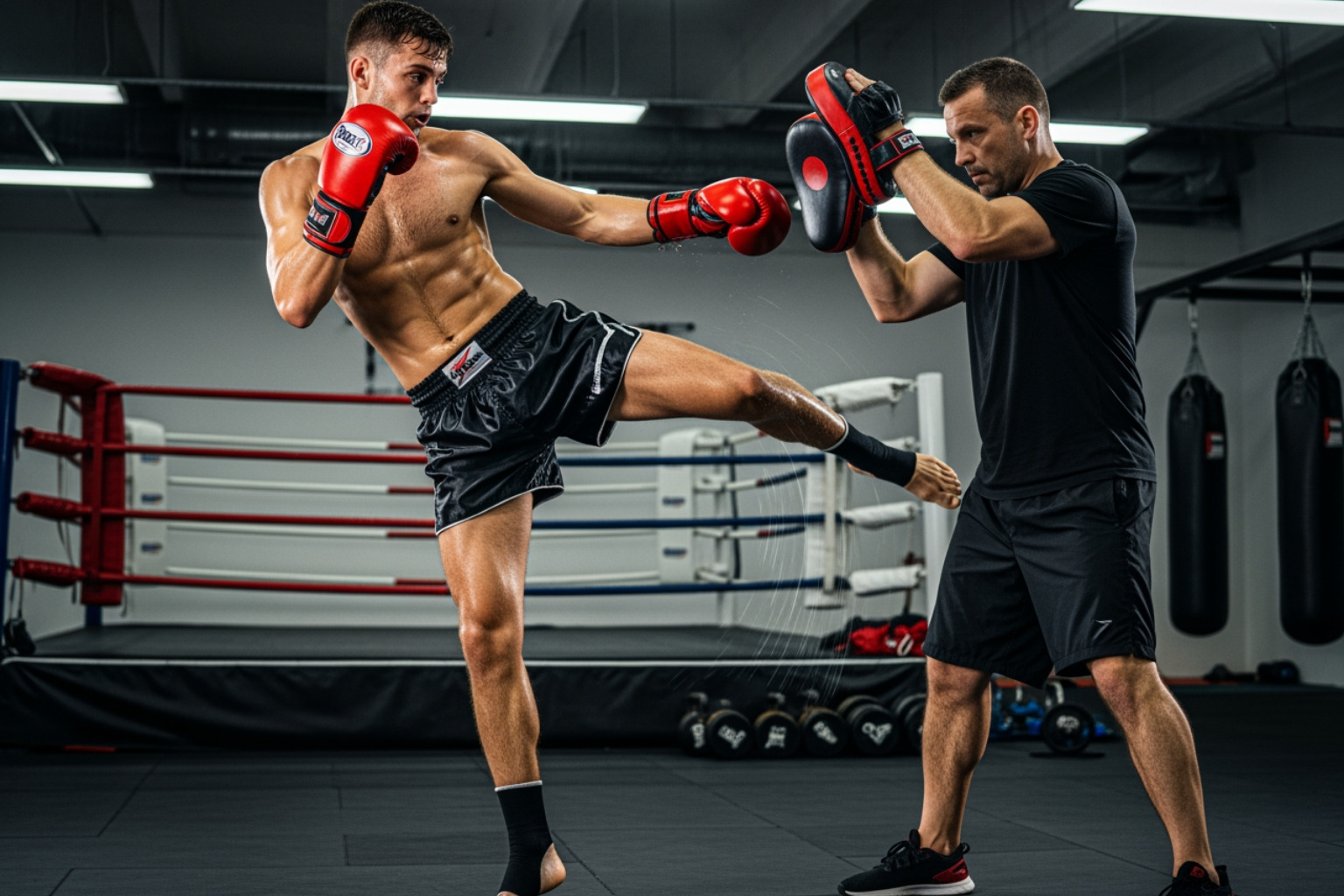
Muay Thai Conditioning: Elite Guide 2025
Why Muay Thai Conditioning is Your Foundation for Dominance
Muay Thai conditioning is the physical and mental training that transforms your body into a high-performance machine. It’s what allows you to deliver devastating strikes, absorb punishment, and maintain relentless pressure for multiple rounds. To do this, you need to build:
The Core Components:
- Strength: Maximum force for powerful strikes and clinch control.
- Power: Explosive force for knockout techniques.
- Speed: Rapid strike delivery and defensive reactions.
- Cardiovascular Endurance: Sustaining high-intensity output across rounds.
- Muscular Endurance: Resisting localized fatigue in your limbs and core.
- Mobility: Full range of motion for kicks, blocks, and movement.
- Core Strength: Rotational power and injury prevention.
Think of it this way: your technique is the weapon, but your conditioning is the warrior wielding it. You can have a perfect roundhouse kick, but without the strength to generate force, the power to make it explosive, and the endurance to throw it in round five, it’s just a pretty movement. Your body is the engine that powers every single technique.
Traditional Muay Thai training—pad work, bag work, and sparring—is brilliant for skill development. However, it often falls short in developing maximal strength and power. Structured strength and conditioning fills this gap, giving you a body capable of executing techniques correctly and powerfully, even under fatigue.
This guide provides a complete blueprint for developing the elite physical resilience that separates good fighters from great ones.
The Pillars of Elite Muay Thai Conditioning

Elite Muay Thai conditioning is about building a complete athlete—one who can strike with power, move with speed, and maintain pressure for five full rounds. It’s a holistic approach that blends physical attributes and mental resilience to optimize performance and prevent injury.
The Primary Components of Conditioning
- Strength and Power: Strength is your ability to generate maximum force, crucial for impactful strikes and clinch control. Power is generating that force quickly, creating explosive, fight-ending techniques.
- Speed: This covers your swiftness of movement and reaction time. Faster strikes are harder to defend, and quick footwork creates openings.
- Cardiovascular and Muscular Endurance: Cardio is your gas tank, allowing you to maintain a high work rate. Muscular endurance is your muscles’ ability to perform repeated actions without fatiguing, so you can keep throwing combinations in the final round.
- Mobility and Core Strength: Mobility is your active, controlled range of motion, essential for high kicks and injury reduction. Core strength is the linchpin that transfers power from your lower to your upper body, providing stability and balance.
- Mental Fortitude: The ability to push through pain and fatigue is what separates fighters who fold from those who finish strong.
Why Strength & Conditioning is Essential
While traditional Muay Thai training builds incredible skill and toughness, it has limitations. It doesn’t adequately develop maximal force or the rate of force development. This is where a structured strength and conditioning (S&C) program becomes a game-changer.
S&C accelerates skill development by making your body more capable of expressing technique. With a foundation of strength and mobility, you can learn and perfect movements faster. It also builds a robust body that can withstand the rigors of training, reducing injury risk by correcting strength imbalances.
Finally, S&C gives you a significant competitive edge. In fights where skill levels are similar, the physically superior fighter often prevails. The misconception that weightlifting makes fighters slow is due to poor programming, not the training itself. Proper S&C is about working smarter to build a body that can express your fighting skills at the highest level.
Building Explosive Power: The Trifecta of Strength, Power, and Speed
To dominate in the ring, you must understand that strength, power, and speed are different attributes that require specific training. When you train all three correctly, your Muay Thai conditioning becomes truly elite.
Strength is your maximum force. Power is how fast you apply that force. Speed is pure velocity. All three matter, but they develop differently.
| Attribute | Definition | Training Goal | Typical Reps/Sets | Example Exercises |
|---|---|---|---|---|
| Strength | Maximum force generation | Increase absolute force | 3-5 reps, 3-5 sets | Squats, Deadlifts, Overhead Press |
| Power | Force generation rate | Increase explosive force | 4-10 reps, 2-3 sets | Kettlebell Swings, Med Ball Throws, Hang Pulls |
| Speed | Maximum velocity | Increase movement quickness | 4-10 reps, 2-3 sets | Box Jumps, Sprints, Band-Resisted Broad Jumps |
The Foundation: Maximal Strength Training
Maximal strength is your foundation. Without it, your power and speed will always have a ceiling. Strength training provides injury resilience, clinch dominance, and increased force potential. The stronger you are, the harder you can hit. This training works through neural adaptations, teaching your nervous system to recruit more muscle fibers more efficiently.
For programming, follow the simple “3-to-5” rule: 3 to 5 exercises, 3 to 5 sets per exercise, 3 to 5 reps per set, with 3 to 5 minutes of rest. This isn’t about getting a pump; it’s about lifting heavy to produce maximum force. Incorporate big compound movements:
- Squats: (Back, Front, or Zercher) for lower body and core strength.
- Deadlifts: (Conventional, Sumo, or Trap Bar) for posterior chain power.
- Overhead Presses: For shoulder strength and a strong guard.
- Rows and Pull-ups: For pulling power in the clinch.
Also include unilateral training (single-leg or single-arm exercises). Because Muay Thai involves frequent weight shifts and balancing on a single leg, exercises like pistol squats and single-leg deadlifts build stability and strength that directly apply to fighting.
Releasing Force: Power & Ballistic Training

Power is strength applied with speed. Ballistic training targets your body’s Stretch-Shortening Cycle (SSC), which works like a spring to generate more force. These exercises involve projecting an object (or your body), allowing you to accelerate through the entire movement.
- Kettlebell Swings: Develop explosive hip extension.
- Medicine Ball Throws: Build explosive core and upper body power.
- Hang ‘hits’ and High Pulls: Teach explosive hip and leg drive.
Program these with 2 to 3 sets of 4 to 10 reps, performed with maximum explosive intent. Rest for 2 to 3 minutes between sets to ensure you are fresh enough to be explosive.
Honing the Edge: Speed & Plyometric Training
Speed is the final piece—the quickness of your movements. Plyometrics improve the SSC with a focus on reactive, explosive movements.
- Box Jumps: Develop explosive leg power.
- Clap Push-ups: Train upper body explosive power.
- Band-Resisted Broad Jumps: Improve horizontal explosive power.
- Jumping Lunges and Squats: Build single-leg and double-leg power.
Like ballistic training, perform plyometrics for 2 to 3 sets of 4 to 10 reps with maximum effort. Schedule them early in your session when your nervous system is primed but not fatigued.
Forging an Unbreakable Gas Tank: Endurance and Stamina

An unbreakable gas tank lets you dominate when others fade. A Muay Thai fight involves explosive bursts followed by recovery, meaning you must train both your aerobic (recovery) and anaerobic (explosive) energy systems. The goal is to maintain technical sharpness and physical output when you’re exhausted.
Cardiovascular Endurance for Relentless Pressure
Your cardiovascular system delivers oxygen to your muscles, allowing you to keep a high pace and recover quickly between rounds.
- Running: Use long-distance running (30-60 minutes at a conversational pace) to build your aerobic base. Add interval sprints (e.g., 10 rounds of 20-second sprints and 40-second walks) to mimic the stop-and-go nature of a fight.
- Jump Rope: A combat sports staple, the jump rope improves cardio, footwork, coordination, and rhythm. Try this 5-minute conditioning drill:
- 1 min: Basic two-foot jumps
- 1 min: Single-leg jumps (30s each leg)
- 1 min: Double-unders
- 1 min: Crisscross jumps
- 1 min: High-knee jumps
Muscular Endurance for Late-Round Dominance
While cardio gets oxygen to the muscles, muscular endurance allows those muscles to keep firing without fatiguing. It’s what keeps your guard up and your kicks sharp in the later rounds.
- Bodyweight Circuits: Combine exercises like push-ups, air squats, burpees, and mountain climbers to build full-body muscular endurance. Try 3 rounds of 30 seconds of work with 15 seconds of rest for each movement.
- Animal Movements: Bear crawls, crab walks, and duck walks build endurance while improving coordination and core stability.
- Heavy Bag Workouts: Sustained heavy bag sessions build fight-specific muscular endurance. Try three 3-minute rounds with a one-minute rest, focusing on continuous output. This teaches your body to maintain striking volume even when exhausted.
Structuring Your Muay Thai Conditioning Program
Effective Muay Thai conditioning requires intelligent programming that complements your technical training, not competes with it. This means using periodization—strategically planning your training to maximize gains and prevent burnout.
Most fighters benefit from 2-3 dedicated S&C sessions per week on non-consecutive days. The key is to make sure these sessions work in harmony with your Muay Thai classes.
Tools like the OOWEE app can be invaluable here. With personalized, voice-guided workouts designed for combat sports, you can structure your conditioning without guesswork, seamlessly integrating it with your existing schedule. More info about our features.
How to Structure Your Training for Different Phases
Your conditioning program should change based on your proximity to a fight. A program should be broken into distinct phases.
- Off-Season (General Preparation): This is your time to build the foundation. Focus on maximal strength with heavier loads and lower reps (3-5 reps per set). Use this phase to address weaknesses and mobility restrictions.
- Pre-Fight Camp (Specific Preparation): As a fight approaches, shift your focus to power, speed, and fight-specific endurance. This means more plyometrics, ballistic exercises, and high-intensity interval training that mimics the demands of a fight.
- Peaking (Competition Phase): In the final weeks, less is more. The goal is to arrive at fight night fresh and sharp. Reduce overall training volume while maintaining intensity. A strategic deload week before the fight is crucial for recovery and adaptation.
Common Mistakes to Avoid in Muay Thai Conditioning
Avoid these common traps to ensure your progress isn’t sabotaged.
- Overtraining: The “more is better” mentality is counterproductive. Your body adapts during recovery, not during the workout. If you’re constantly exhausted or getting injured, you’re likely doing too much.
- Neglecting Strength Training: Many fighters turn every session into a conditioning session. Without a foundation of maximal strength, you limit your power potential and increase injury risk.
- Poor Form: Sacrificing technique to lift heavier weight is a recipe for injury. Perfect form with moderate weight is always better than sloppy form with heavy weight.
- Ignoring Mobility: Strength and cardio are useless if you’re too stiff to move properly. Mobility work is essential for both performance and longevity.
- Skipping Recovery: You can’t out-train poor sleep and nutrition. Aim for 8+ hours of sleep and fuel your body with proper nutrients. These are requirements, not luxuries.
Frequently Asked Questions about Muay Thai Conditioning
Here are answers to some of the most common questions about implementing Muay Thai conditioning into your routine.
How do I balance conditioning with my regular Muay Thai classes?
Balance is everything. Your technical training is always the priority. Schedule your 2-3 weekly S&C sessions on separate days from your most demanding Muay Thai classes (like heavy sparring). If you must train on the same day, do your S&C in the morning and technical work in the evening, or vice-versa, allowing for recovery. Most importantly, listen to your body. Constant exhaustion is a sign you need to rest, not train more.
Should I lift heavy weights if I’m worried about getting slow?
This is a common myth. Lifting heavy weights with proper programming will make you faster and more powerful, not slower. When you train for strength correctly (low reps, heavy weight, long rest), you are primarily training your nervous system to recruit muscle fibers more quickly and efficiently. This neural adaptation is the foundation of explosive power. The fighters who get slow are training like bodybuilders (high reps, short rest). Our approach combines heavy lifting with explosive movements like box jumps and medicine ball throws to ensure your strength translates directly to speed.
How long does it take to see results from a conditioning program?
Results come in phases, but you’ll feel a difference sooner than you think.
- In a few weeks: You’ll notice neural adaptations. You’ll feel more coordinated, and techniques will feel crisper as your body learns to use its strength more efficiently.
- After a few months: You’ll see significant gains in strength and endurance. Your strikes will be heavier, and you’ll recover faster between rounds.
- Six months and beyond: This is where you build longevity. You’ll be more resilient to injury and able to train consistently without breaking down.
The most important factor is consistency. A well-structured program performed consistently over a year will always beat going all-out for a month and then burning out. Trust the process, and if you need help staying on track, the OOWEE app is designed to keep your training structured and consistent.
Conclusion: Condition for Victory
We’ve covered the blueprint for elite Muay Thai conditioning. The truth is simple: your technique is the weapon, but your conditioning is the warrior wielding it. Without the physical resilience to execute techniques powerfully, the endurance to maintain pressure, and the mobility to move fluidly, even the best skills fall short.
What separates good fighters from dominant ones is a commitment to a balanced, structured approach that addresses every pillar of performance—strength, power, speed, and endurance. It’s the athlete who understands that recovery isn’t weakness, but the key to adaptation and longevity.
This is where smart programming makes all the difference. Having a structured plan that adapts to your needs is invaluable. Our OOWEE app is built for this, providing personalized, voice-guided workouts that integrate with your music and keep your conditioning on track without the guesswork. Discover how OOWEE can revolutionize your training.
Building elite conditioning is a marathon, not a sprint. Every session, every rep, and every night of good sleep compounds over time. You’re not just preparing for your next fight; you’re building a body and mind that can express the art of Muay Thai at its highest level. Condition for victory, train smart, and trust the process.