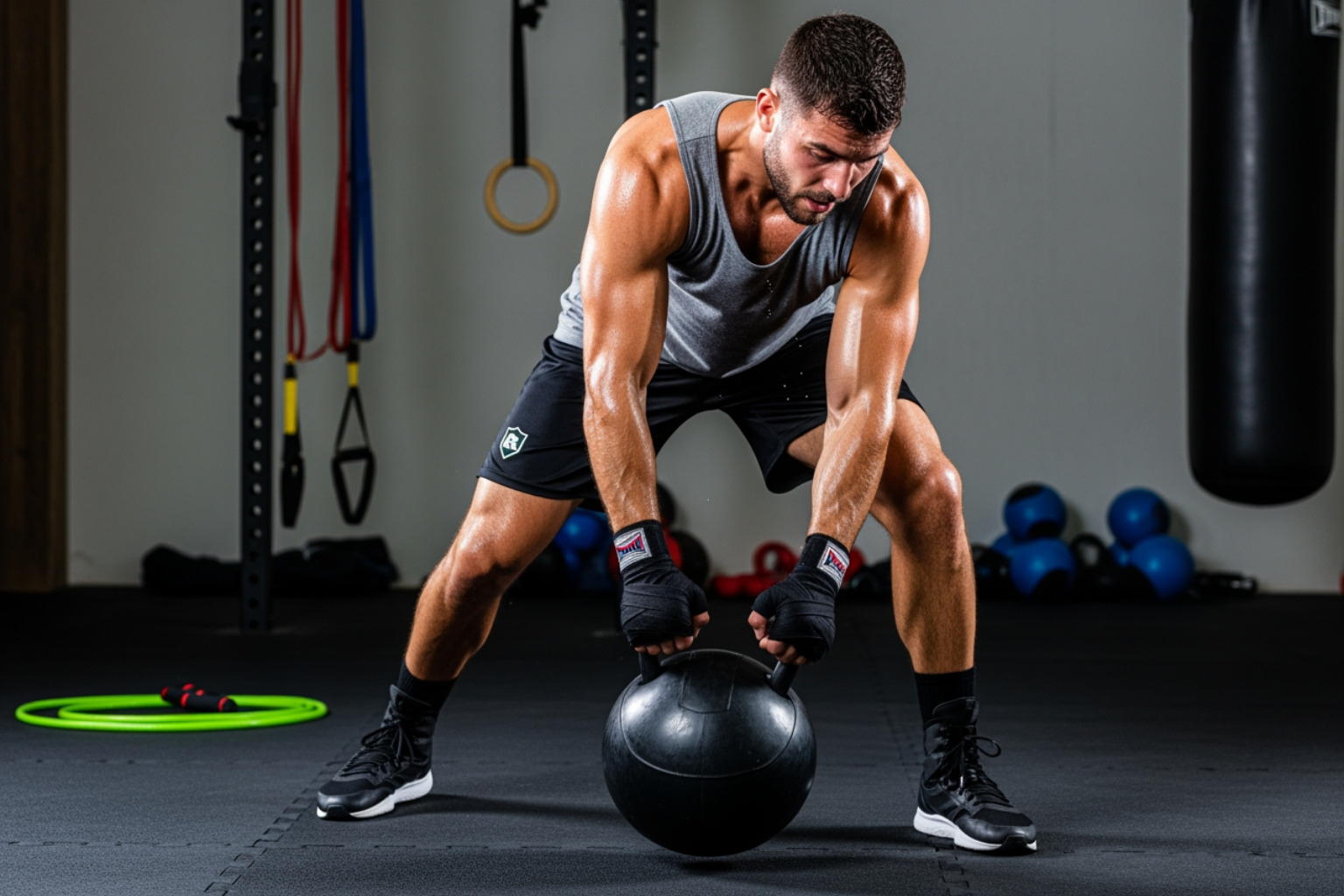
Boxing and Conditioning: 3 Ultimate Tips
Why Boxing and Conditioning Are Inseparable
Boxing and conditioning are inseparable. Even the most skilled fighter will crumble under fatigue. Throwing crisp punches in round one means nothing if you’re gasping for air by round three.
Quick Answer: Boxing conditioning is the physical preparation that allows you to sustain high-intensity effort throughout a fight. It encompasses:
- Aerobic capacity (77% of energy production) – powers sustained effort and recovery.
- Anaerobic alactic system (19% of energy) – fuels explosive punch combinations.
- Anaerobic lactic system (4% of energy) – supports repeated high-force actions.
- Muscular endurance – maintains punch output and defensive movements.
- Core stability – transfers power from legs to fists efficiently.
Boxing demands explosive movements while managing fatigue, recovering quickly, and maintaining technique under stress. Research shows elite amateur boxers have VO2max values comparable to triathletes (around 64 ml.kg-1.min-1), highlighting the sport’s cardiovascular demands.
Many fighters still rely on outdated methods, training hard but not smart. This guide breaks down the science of boxing conditioning into practical strategies, exploring energy systems, effective exercises, and how to structure your training for peak fight-night readiness.

The three energy systems work together during boxing, with aerobic metabolism contributing the most (77%), followed by the anaerobic alactic system (19%) for explosive bursts, and anaerobic lactic (4%) for sustained high-intensity efforts.
The Engine of a Fighter: Understanding Boxing’s Physiological Demands
To excel at boxing and conditioning, you must understand what happens inside your body during a fight. Boxing is a high-intensity intermittent sport, constantly shifting between explosive bursts and brief moments of lower intensity. This taxes all three of your body’s energy systems.

Surprisingly, aerobic metabolism provides 77% of your energy during a match. This system uses oxygen for sustained effort and, crucially, helps you recover between explosive exchanges. Your VO2 max—a measure of oxygen use—is a critical indicator. Elite amateur boxers average around 64 ml.kg-1.min-1, similar to triathletes.
The phosphocreatine (alactic) system contributes about 19% of your energy, powering immediate, explosive actions like fast combinations or sudden defensive moves. The anaerobic glycolysis (lactic) system adds the final 4%, supporting repeated high-intensity efforts and causing that muscle burn. Your ability to tolerate and clear these byproducts is key to maintaining output under fatigue.
Smart boxing and conditioning means training all three systems intelligently. For a deeper dive into these physiological demands, check out the Olympics library recommendations.
| Feature | Amateur Boxing | Professional Boxing |
|---|---|---|
| Round Duration | 2-3 minutes | 3 minutes |
| Total Rounds | 3 | 4-12 (or more) |
| Pacing Strategy | High intensity throughout, frequent bursts | Strategic pacing, sustained output over longer duration |
| Activity-to-Break Ratio | Very high (e.g., 18:1 for elites) | High, but with more emphasis on sustained exchanges |
Amateur vs. Professional Demands
Conditioning demands shift between amateur and professional boxing.
Amateur boxing (3 rounds) is a sprint, demanding a relentless, high pace. Elite amateurs can have activity-to-break ratios as high as 18:1, requiring exceptional aerobic capacity for rapid recovery between bursts.
Professional boxing (4-12 rounds) is a marathon, requiring strategic energy management. A robust aerobic base is even more critical to ensure you’re still sharp and powerful in the championship rounds.
Activity Profiles: From Novice to Elite
A boxer’s movement and punch output evolve with experience. Novice boxers might have a 9:1 activity-to-break ratio, which drops as fatigue sets in.
In contrast, Analysis of Olympic boxing athletes shows elite amateurs maintain ratios as high as 18:1. They average around 20 punches per minute, but the quality is higher, and their activity rate often increases as rounds progress. Elite professionals can throw over 100 punches per round, maintaining this output across the entire bout.
Winners maintain a higher frequency of attacking movements, particularly jabs and combinations. Your conditioning must support aggressive, effective offense throughout the fight, not just help you survive.
The Ultimate Guide to Boxing and Conditioning Methods
Effective boxing and conditioning creates adaptations that directly translate to better ring performance. It requires a blend of general fitness to build your engine and sport-specific conditioning to fine-tune it for a fight.

Cardiovascular Training: The Cornerstone of Endurance
Your cardiovascular system is your lifeline, delivering oxygen and clearing waste.
- Roadwork: Long, steady runs (30-40 minutes at 65-75% max heart rate) build your aerobic base, the foundation for multi-round endurance.
- Jump Rope: A boxer’s essential tool, it boosts cardio fitness while developing rhythm, footwork, and calf endurance.
- High-Intensity Interval Training (HIIT) & Sprint Interval Training (SIT): These methods mimic the intensity of a fight. HIIT uses longer high-intensity efforts (e.g., 4 minutes hard, 2 minutes recovery) to improve heart efficiency. SIT uses maximal, all-out sprints (up to 30 seconds) with long rest to improve your muscles’ ability to handle explosive efforts. These modern approaches are more specific to boxing’s demands than steady-state cardio alone.
Strength & Power Development
Forget the myth: weights don’t make you slow. Structured strength training is crucial for boxing and conditioning, improving force production so you hit harder with less energy.
- Foundational Lifts: Focus on compound movements like Squats, Deadlifts, and the Overhead Press in low rep ranges (3-6 reps) to build full-body strength without unnecessary bulk. Weighted carries build grip, core stability, and durability.
- Plyometrics & Explosive Work: Bridge the gap between strength and speed with exercises like Box Jumps, Medicine Ball Slams, and Kettlebell Swings. These train your muscles to produce maximum force in minimum time, which is the key to punching power.
Boxing-Specific Drills
General conditioning builds your engine; specific drills teach it to perform under fight conditions.
- Heavy Bag Work: Integrate conditioning goals into bag sessions. Set output targets for power and volume, varying intensity to simulate fight scenarios.
- Shadow Boxing: Use it as a conditioning tool with high-paced intervals, incorporating footwork and defensive moves to build stamina while refining technique.
- Focus Mitts: Working with a coach on mitts is prime fight simulation, forcing you to maintain accuracy and output under fatigue.
Integrating conditioning into skill work is key. It ensures your fitness supports your technique when you’re tired. At OOWEE, our voice-guided workouts are designed to merge these elements, keeping you on track through the toughest rounds.
Building a Complete Fighter: Key Conditioning Components
A boxer’s body is a kinetic chain. Force travels from the ground through the legs and core to the fist. Optimizing each link is vital for superior boxing and conditioning.
Explosive Power for Knockout Punches
Impactful punches require explosive power, which is the ability to generate maximum force in minimal time (rate of force development). This is fueled by your alactic energy system and fast-twitch muscle fibers.
- Explosive Lifts & Plyometrics: Exercises like power cleans, jump squats, and box jumps train your body to move loads quickly and develop reactive strength.
- Medicine Ball Throws: Rotational throws and slams are excellent for developing core power and transferring force from your hips to your hands, simulating the torque of a powerful hook.
Train for power with short, maximal efforts (e.g., 5-6 reps or 7-10 seconds) followed by long rest periods (2-5 minutes).
Muscular Endurance for Sustained Attack
Muscular endurance is your muscles’ ability to perform repeated contractions without fatiguing. This involves your capacity to tolerate and buffer lactic acid.
- Muscle Buffering Sessions: Improve your body’s ability to handle acidosis (the muscle burn) with repeated high-intensity intervals, like 2-minute sprints followed by 3 minutes of recovery.
- Circuit Training & High-Rep Work: Combine exercises with minimal rest or perform longer rounds on the heavy bag to build the stamina needed to keep throwing punches late in a fight.
The Crucial Role of Core Strength and Stability
Your core is the powerhouse linking your lower and upper body. A weak core leaks power and increases injury risk.
- Core Function: A strong core efficiently transfers rotational power into punches and provides stability for defense.
- Key Exercises: Focus on anti-rotation exercises like the Pallof Press to resist twisting, Landmine Twists for controlled rotational power, and Planks and Suitcase Carries for isometric strength and stability.
Grip and Forearm Strength for Punch Security
Strong grip and forearms are essential for boxing and conditioning. They stabilize the wrist at impact, preventing injury and ensuring maximum force transfer. They are also crucial for clinch control.
- Training Methods: Use Fat-Grip Training on barbells, perform old-school Rice Bucket Drills, or use Hand Grippers and Towel Pull-ups to build crushing grip strength and endurance.
Smart Training: Programming, Integration, and Recovery
The best exercises are useless without an intelligent plan. Smart boxing and conditioning is about working strategically—knowing when to push and when to pull back.
Programming and Periodization for Peak Performance
Periodization is smart planning. Training is broken into blocks, each with a specific purpose.
- General Preparation: Early on, you build a foundation of general strength and aerobic capacity.
- Specific Preparation: As you progress, training becomes more boxing-specific, emphasizing explosive power and high-intensity intervals that mimic ring action.
- Competition Preparation: 6-8 weeks before a fight, intensity ramps up and conditioning sessions mirror fight demands (e.g., 3-minute rounds, 1-minute rest).
A critical mistake is training hard right up to fight night. Tapering in the final 7-10 days is non-negotiable. You reduce training volume and intensity to allow your body to fully recover, replenish energy stores, and sharpen your nervous system. You want to enter the ring fresh and explosive, not depleted.
A good program balances skill work, sparring, and conditioning, often placing high-intensity sessions on separate days from heavy sparring to manage fatigue.
Optimizing Recovery to Maximize Gains
Your body gets stronger during recovery, not the workout itself. Neglecting recovery means you’re just getting worn out, not better.
- Active Recovery: Light movement like a gentle jog, stretching, or yoga on rest days helps flush out metabolic waste and reduces muscle soreness without adding training stress.
- Nutrition: This is where recovery truly happens. After training, consume protein (chicken, fish, eggs, protein shake) to repair muscle and complex carbohydrates (whole grains, sweet potatoes) to refuel glycogen stores. Healthy fats support hormone production.
- Hydration: Even mild dehydration hurts performance and recovery. Sip water throughout the day and consider electrolytes after intense sessions.
- Sleep: The most powerful recovery tool. Aim for 7-9 hours of quality sleep per night for deep repair, hormone release, and nervous system reset.
Recovery isn’t lazy—it’s strategic. The smartest fighters prioritize it to maximize their gains.
Frequently Asked Questions about Boxing Conditioning
Here are answers to common questions about boxing and conditioning.
How long does it take to get in boxing shape?
It depends on your starting point. Beginners may feel initial adaptations in 4-6 weeks. However, achieving true “fight fitness”—the ability to maintain power and technique through multiple rounds—takes months of consistent, intelligent work. Your starting fitness level and the quality of your program are huge factors. The key isn’t speed; it’s consistency over time.
Is running necessary for boxing?
No, but it is beneficial. Traditional roadwork is great for building an aerobic base and mental toughness. However, methods like HIIT and sprint intervals often better mimic the demands of a fight. Other excellent, lower-impact options include cycling, rowing, swimming, and the Airdyne bike. The best approach is to blend different methods that suit your goals and body.
Can you build muscle with boxing conditioning?
Yes, but it builds lean, functional muscle, not bulky mass. Conditioning work like heavy bag drills and plyometrics will develop a defined, athletic physique with strong shoulders, legs, and core. Boxing is an endurance and power sport. For significant muscle growth (hypertrophy), you would need a dedicated strength training program with progressive overload. Boxing conditioning builds a body for function, creating a powerful, enduring fighter without unnecessary bulk.
Conclusion
Boxing and conditioning are not separate disciplines; they are two sides of the same coin. Perfect technique means little without the engine to sustain it through the final bell.
The science is clear: your performance relies on a dominant aerobic system (77% of energy), supported by anaerobic systems for explosive bursts. Smart training develops this entire engine, from your core and grip strength to your muscular endurance.
This is about training smart, not just hard. It means using modern, science-backed methods to build a specific kind of fitness that combines endurance with explosive power. The most successful fighters are the ones who train the most intelligently.
Build your aerobic base, develop explosive power, forge muscular endurance, and strengthen your core. Most importantly, prioritize recovery—it’s where your body rebuilds itself stronger. These principles are the foundation for any fighter, from amateur to pro.
For personalized, voice-guided workouts that apply these exact principles and integrate seamlessly with your music, explore the OOWEE app. We’ve built a platform that understands what fighters actually need—customizable training that adapts to you, with vocal cues that keep you focused while your favorite tracks keep you motivated. Learn more about our features and see how we’re helping fighters train smarter, not just harder.
Now get out there and build your engine.