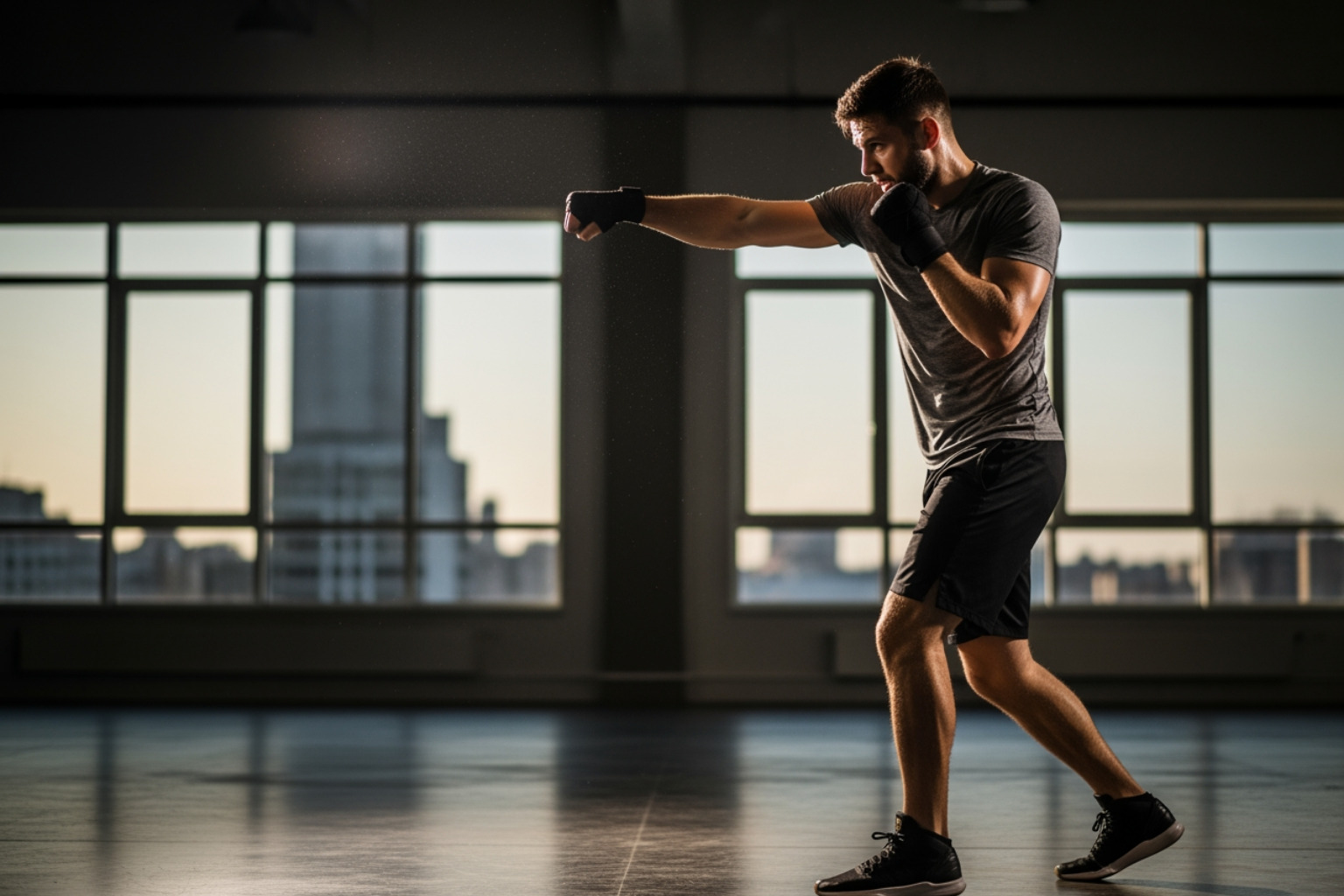
Shadow Boxing: 5 Ultimate Benefits to Boost Form
The Solitary Dance of a Fighter
Shadow boxing is a combat sport exercise where you throw punches at the air as if fighting an imaginary opponent. It’s one of boxing’s most fundamental training methods—and it’s far more powerful than it looks.
Quick Answer: What is Shadow Boxing?
- Definition: Practicing punches, footwork, and defensive movements without a physical opponent or equipment
- Primary Purpose: Develop technique, improve rhythm, build muscle memory, and prepare muscles for training
- Duration: Typically done in 3-minute rounds (matching fight round length)
- Location: Anywhere with 5-6 feet of space—gym, home, or outdoors
- Equipment Needed: None (though a mirror helps with form correction)
You’ve probably seen it before: a fighter moving rhythmically in front of a mirror, hands up, feet gliding across the floor with purpose. Every punch snaps back to guard. Every step resets their stance. They’re fighting someone only they can see.
This isn’t just a warm-up routine or a way to look cool. Shadow boxing is where champions are built—one invisible opponent at a time.
Why it matters: Shadow boxing forces you to focus entirely on your technique without the distraction of hitting a target. It builds the coordination between your upper and lower body while maintaining perfect balance. It trains your mind to visualize opponents and react strategically. And it does all this while giving you a serious cardiovascular workout that can burn significant calories.
Black Nova Scotian boxer George Dixon is credited with developing this technique in the late 1800s. Today, every serious fighter—from beginners learning their first jab to world champions preparing for title fights—shadow boxes as part of their daily routine.

The beauty of shadow boxing? You don’t need a gym membership, expensive equipment, or a training partner. Just you, some space, and the commitment to master your craft.
More Than Just Punching Air: The Core Benefits and Origins
It might look like just punching air, but shadow boxing is a complete workout for the body and mind. It’s not just a warm-up; it’s a foundational training method where every movement builds strength, sharpens reflexes, and trains the brain to think like a fighter.
Let’s break down its powerful benefits.
Physical Benefits
Shadow boxing is a full-body workout. Your core stabilizes you, your legs drive movement, and your arms snap out with speed and control.
- Cardiovascular Health: Your heart rate climbs quickly, building endurance and burning calories. The American Heart Association recommends at least 150 minutes of moderate-intensity exercise per week, and shadow boxing is a perfect way to meet that goal.
- Muscle Toning: While you won’t bulk up, you will develop lean, defined muscles in your shoulders, arms, core, and legs. This is functional strength that makes you faster and more explosive.
- Agility and Coordination: The constant footwork—pivots, side steps, and direction changes—sharpens your reflexes and improves balance, making your movements more fluid.
Mental Benefits
Shadow boxing is as mental as it is physical, often called “meditation in motion.”
- Focus and Visualization: You must visualize an opponent, anticipating their moves and reacting strategically. This builds a fighter’s instinct.
- Stress Relief: It’s a powerful and healthy outlet for frustration. Channeling energy into crisp punches is cathartic and can quickly improve your mood.
- Confidence: Training alone removes pressure and judgment. As your technique and stamina improve at your own pace, your confidence will grow both in and out of the gym.
Historical Origin
The technique as we know it today is credited to George Dixon, a Black Nova Scotian boxer from the late 1800s. Dixon was the first Black world champion in any weight class and a true innovator. His development of shadow boxing as a deliberate practice method helped shape modern boxing, proving that simple exercises can have a profound impact.
The Art of Shadow Boxing: Mastering the Fundamentals
Shadow boxing is about perfecting movement and technique. It’s a space to refine your skills without the pressure of an opponent.
How to Perform
Effective shadow boxing requires focusing on form, fluidity, and breathing. Every movement should have a purpose.
- Footwork: Stay light on your feet, constantly moving forward, backward, and laterally with small, efficient steps.
- Balance: Maintain a solid, balanced stance so you’re always ready to attack or defend.
- Breathing: Breathe rhythmically. Exhale sharply with each punch to stay relaxed and powerful.
- Frequency and Duration: Beginners should start with 10-15 minute sessions. As you improve, you can increase the duration. Aim for 3-minute rounds to build fight-specific endurance.
Beginner’s Guide to Shadow Boxing
Focus on good form before adding speed.
- Correct Stance: Stand with feet shoulder-width apart, dominant leg back. Keep knees slightly bent, hands up to guard your face, elbows tucked in, and chin down.
- Basic Footwork: Practice moving in all directions (forward, back, side-to-side) and pivoting. Keep your movements small and your stance consistent.
- Basic Punches: Master the four fundamental punches:
- Jab: A quick, straight punch with your lead hand to gauge distance.
- Cross: A powerful, straight punch with your rear hand, rotating your hips for power.
- Hook: A curved punch with either hand, powered by torso rotation.
- Uppercut: An upward punch with either hand, targeting the chin or body.
- Simple Combinations: String punches together, like a jab-cross or jab-cross-hook. Focus on fluidity and always returning your hands to the guard position.
Structuring Your First Routine
A structured routine builds consistency and maximizes results.
- Warm-up (5-10 minutes): Start with light shadow boxing at half-speed and dynamic stretches like arm circles and leg swings to loosen up.
- Round Structure: Use 3-minute rounds with 30-60 seconds of rest.
- Round 1: Movement (3 min): Focus only on footwork. Move in all directions while maintaining your stance and guard. Use a mirror to check your form.
- Round 2: Single Punches (3 min): Practice each punch individually. Concentrate on proper form and snapping your hand back to guard.123123
- Round 3: Basic Combinations (3 min): Combine punches (e.g., jab-cross-hook). Focus on smooth transitions and constant movement.
- Cool-down (5-10 minutes): Finish with light stretching for your arms, shoulders, back, and legs to aid recovery.
Shadow Boxing vs. The Heavy Bag vs. Sparring
If you’re new to combat sports training, you might wonder how shadow boxing fits alongside other training methods. The truth is, while they might look similar on the surface, shadow boxing, heavy bag work, and sparring each play completely different roles in our development as fighters.
Think of it this way: shadow boxing is our private workshop where we perfect the blueprint. Heavy bag work is where we test that blueprint with real force. And sparring? That’s where we take everything we’ve learned and apply it against someone who’s actively trying to stop us.
Shadow boxing is all about precision and refinement. Without the distraction of hitting something or defending against someone, we can focus entirely on our technique. Are our punches crisp? Is our footwork smooth? Are we maintaining proper balance throughout our combinations? This is where muscle memory gets built, one invisible opponent at a time. It’s our safest training method with virtually no risk of injury.
Heavy bag work changes the game by introducing resistance and impact. When our fist connects with that bag, we immediately learn whether we’re generating real power or just going through the motions. The bag doesn’t lie—it shows us if our hip rotation is weak, if our stance is off, or if we’re dropping our hands. It’s fantastic for building endurance and conditioning, and it lets us throw full-power combinations without holding back.
Sparring is where everything comes together under pressure. Now we’re facing an unpredictable opponent who moves, counters, and forces us to adapt in real time. It’s the ultimate test of our timing, strategy, and defensive skills. But it also carries the highest risk of injury, which is why proper protective gear and a respectful training partner are essential.

Here’s how these three training methods stack up:
| Aspect | Shadow Boxing | Heavy Bag Work | Sparring |
|---|---|---|---|
| Objective | Technique, Rhythm, Visualization, Conditioning | Power, Conditioning, Impact, Endurance | Application, Strategy, Defense, Timing vs. Live Opponent |
| Equipment Needed | None (mirror optional) | Heavy Bag, Gloves, Hand Wraps | Partner, Gloves, Headgear, Mouthguard, Hand Wraps |
| Risk of Injury | Very Low | Low (if proper technique is used) | Moderate to High |
| Primary Benefit | Muscle Memory, Fluidity, Mental Focus, Accessibility | Strength, Power Generation, Cardiovascular Output | Real-time Adaptation, Fight IQ, Confidence |
The beautiful thing about shadow boxing is its accessibility. While heavy bag work requires equipment and sparring requires a partner and safety gear, we can shadow box anywhere with just a few feet of space. It’s why champions still shadow box daily, even after years in the sport—it’s the foundation that everything else builds on.
The smartest approach? Use all three in our training. Start each session with shadow boxing to warm up and dial in our technique. Move to the heavy bag to develop power and conditioning. And when we’re ready, test everything in controlled sparring sessions. Each method feeds into the others, creating a complete training system that develops us as well-rounded fighters.
Level Up Your Practice: Advanced Techniques and Common Pitfalls
Once you’ve nailed the fundamentals, you can refine your personal style and push your limits. There’s always another level to reach by incorporating defense, experimenting with styles, or adding light equipment.

Different Styles
Explore different approaches to find what feels natural.
- Long Method: Ideal for fighters with a long reach. Focus on constant footwork (shuffles, pivots) while throwing long-range jabs and crosses to control distance and stay on the outside.
- Short Method: For aggressive pressure fighters. Practice constant head movement, slips, and ducks to get inside an opponent’s range for powerful hooks and body shots.
Incorporating Defense
Shadow boxing isn’t just about offense. Weave in defensive movements to simulate a real fight.
- Head Movement: Practice slips (moving your head just past a punch) and rolls (ducking under a punch in a U-shape) to make yourself an elusive target.
- Blocks and Parries: Use your hands and forearms to deflect imaginary strikes.
- Combine Offense and Defense: The goal is to flow seamlessly. Slip a jab, then counter with a cross. Roll under a hook and come up with an uppercut.
Using Equipment
While not required, light equipment can improve your training.
- Light Dumbbells (1-3 lbs max): These increase intensity and build shoulder endurance. When you drop them, your hands will feel faster. Using light dumbbells can help build and maintain muscle mass. Crucially, never use heavy weights, as they can cause injury and promote bad form.
- Resistance Bands: Attach them to a fixed point to add a different challenge to your punches and movements.
- Hand Wraps: Wearing wraps helps get you in the right mindset and supports your wrists.
Common Mistakes in Shadow Boxing and How to Fix Them
Watch out for these common bad habits. Using a mirror is a great way to self-correct.
- Dropping Hands: Always snap your hands back to your guard after every punch.
- Forgetting Footwork: Keep your feet moving constantly. If you’re standing still, you’re not getting the full benefit.
- No Visualization: See your opponent. React to their imaginary movements to make the drill mental as well as physical.
- Throwing Only Power Punches: Vary your intensity. Mix in light, fast punches with powerful ones to build endurance and precision.
- Holding Your Breath: Breathe rhythmically, exhaling sharply on each punch.
- Bad Posture: Maintain a balanced, athletic stance. Avoid slouching or standing too upright.
Incorporating Shadow Boxing into Other Routines
Its versatility makes it great for other disciplines.
- Muay Thai: Incorporate kicks, knees, and elbows into your combinations. Practice defensive leg checks and clinch work.
- MMA: Practice transitions between striking and struggling. Mix punch combinations with level changes for imaginary takedowns or sprawls.
- General Fitness: Use shadow boxing as a dynamic warm-up, a cardio burst in a circuit, or as a form of active recovery.
Frequently Asked Questions about Shadow Boxing
How often should a beginner shadow box?
For beginners, we recommend 10-15 minute sessions, 3-4 times a week. The initial focus should be on building proper form and technique, not speed or duration. Rushing can lead to bad habits. As you get more comfortable and your fitness improves, you can gradually increase the length and frequency of your sessions, working up to 30-minute sessions on most days for excellent cardiovascular benefits.
Can you build muscle with shadow boxing?
Shadow boxing primarily builds muscle endurance and definition, not significant bulk. It’s an excellent conditioning tool that tones the shoulders, arms, core, and legs. The result is lean, functional muscle that improves speed, agility, and stamina. For adding significant muscle mass (hypertrophy), you’ll need to pair shadow boxing with a dedicated strength training program.
Is it better to shadow box with or without weights?
Both methods are valuable and should be used based on your goals.
- Without weights is best for perfecting speed, fluidity, and form. It allows you to focus purely on technique and building muscle memory without added strain. Most of your shadow boxing should be done without weights.
- With light weights (1-3 lbs), you can increase workout intensity, build shoulder endurance, and add a cardiovascular challenge. After a round with light weights, your unweighted punches will feel noticeably faster. Using light dumbbells can help build and maintain muscle mass.
Warning: Avoid heavy weights (anything over 3 lbs). Using them can strain your joints, alter your punching mechanics, and lead to injury. The goal is endurance and speed, not heavy lifting.
Conclusion: Your First Round Starts Now
So here we are. We’ve traveled from George Dixon’s innovation in the late 1800s to the modern gym floor where fighters of all levels still rely on this timeless training method. We’ve explored how shadow boxing sharpens your technique with every purposeful movement, builds your cardiovascular endurance round by round, and develops the mental focus that separates good fighters from great ones.
What makes shadow boxing truly special isn’t just what it does for your body—it’s the accessibility. You don’t need a gym membership, expensive equipment, or even a training partner. Just a few feet of space and the willingness to face your invisible opponent. Whether you’re training for your first amateur bout, cross-training for MMA or Muay Thai, or simply looking for an engaging full-body workout, shadow boxing meets you where you are.
It’s your personal laboratory for perfecting combinations. Your moving meditation for stress relief. Your foundation for everything that comes after—the heavy bag, the mitts, the ring itself. Every world champion started exactly where you are now: throwing that first tentative jab at the air, feeling a bit awkward, wondering if they’re doing it right.
The difference between them and everyone else? They kept going. They refined their stance, perfected their footwork, visualized their opponents, and put in the rounds. They understood that greatness isn’t built in dramatic moments—it’s built in the quiet consistency of daily practice.
Your journey to improved rhythm, sharper timing, and genuine fighting confidence begins with a single punch. The question isn’t whether you’re ready—it’s whether you’re willing to start.
Start your personalized training journey today with the OOWEE app. Get voice-guided Boxing and Muay Thai training that works seamlessly with your music, offering customizable workouts custom to your goals. Let us guide you through proper technique, effective combinations, and structured rounds that build real skill. Your first round starts now—and we’ll be in your corner every step of the way.