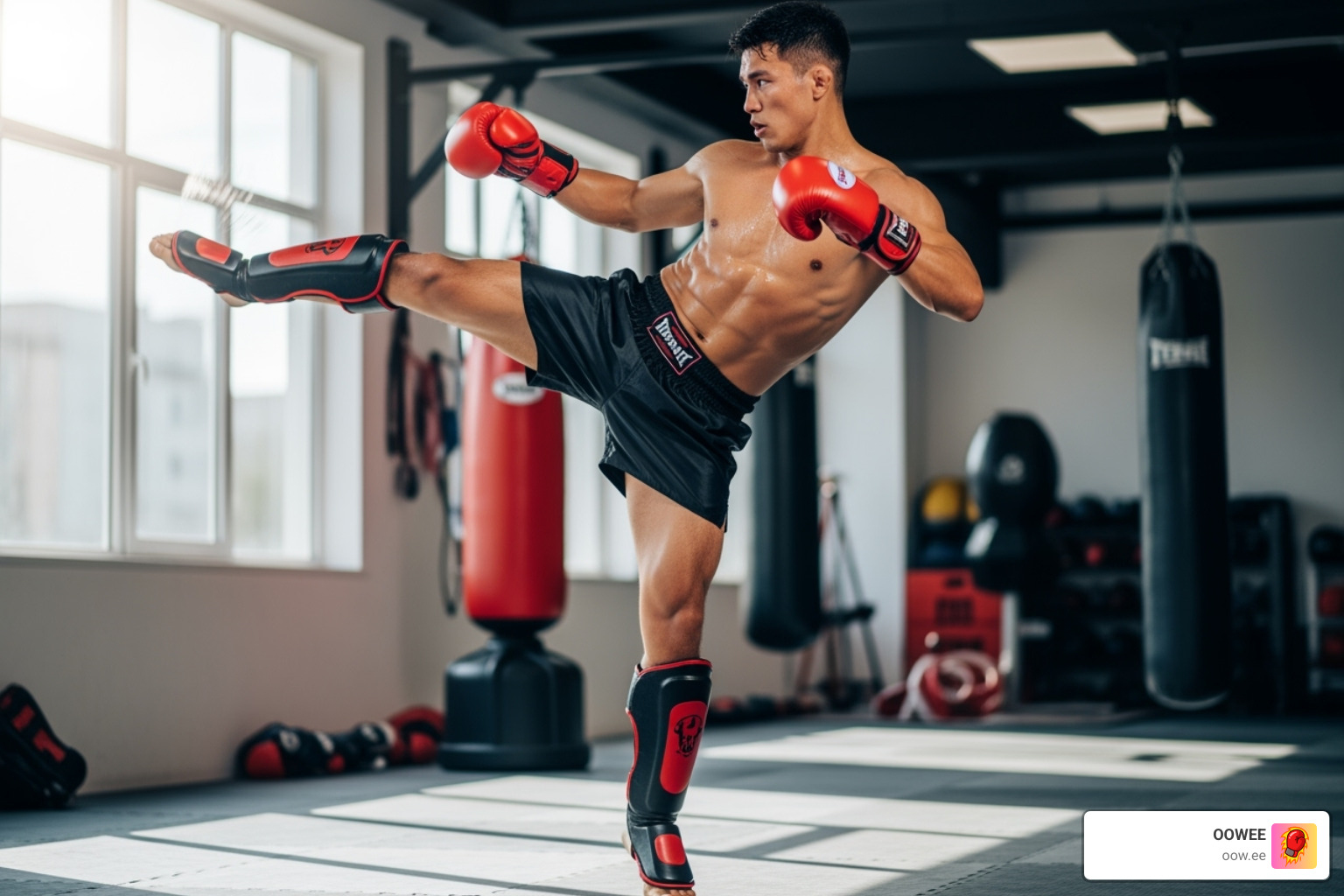
Conditioning for teeps: 5 Pillars of Power!
Why Conditioning for Teeps Separates Champions from Beginners
Conditioning for teeps is the systematic development of leg power, core stability, balance, and endurance needed to execute devastating push kicks that control fights. Most fighters treat the teep as just another technique, but champions understand it requires dedicated physical preparation to become truly effective.
Essential Components of Teep Conditioning:
- Leg & Hip Power – Squats, lunges, and single-leg exercises for explosive drive
- Core Stability – Anti-rotation training and stability work for force transfer
- Balance Training – Single-leg drills and proprioceptive exercises for unshakeable base
- Explosive Speed – Plyometric exercises for rapid-fire execution
- Fight Endurance – Repetitive conditioning for late-round power maintenance

As one experienced fighter shared: “This 14-year-old kid just blasted me off my feet across the ring with a teep kick… I can’t believe he had that much power!” That power didn’t come from technique alone – it came from proper conditioning.
The teep isn’t just a distance management tool. It’s a fight-controlling weapon when backed by the right physical preparation. Champions like Tawanchai and Buakaw don’t just practice their teeps – they condition their bodies specifically for maximum teep effectiveness.
Without proper conditioning, your teep becomes a “beep” instead of a devastating strike. The difference lies in building the athletic foundation that transforms a simple push kick into a game-changing weapon.

The Foundation: Building Raw Power for Your Teep
Here’s the truth about conditioning for teeps: that devastating push kick you see elite fighters use isn’t just about perfect technique. It’s built on a foundation of raw leg and hip power that takes months to develop properly.
Think of your lower body as a loaded spring. When you execute a teep, you’re not just flicking your leg out—you’re driving through your opponent with explosive force generated from your glutes, quads, and hamstrings. But here’s what separates beginners from champions: it’s all in the hips, not just the legs.
Many experienced fighters will tell you this same thing. The hip drive is what transforms a weak push into a fight-stopping weapon, similar to how we generate devastating power in knee strikes. Your job is training your body to transfer this hip power efficiently through your striking leg.

Mastering the Squat for Teep Dominance
Squats are your secret weapon for building teep power. Here’s why: a teep is essentially a one-legged squat with explosive forward drive.
Picture this—when you teep, you’re basically stomping forward with the ball of your foot instead of stomping straight down. The muscle mechanics are nearly identical to a squat, just rotated 90 degrees.
Front squats and low bar back squats should become your best friends. Low bar back squats are particularly valuable because they maximize the power you can generate from your hips, which translates directly to increased teep devastation.
Depth matters more than you think. The deeper you squat, the more you activate your glutes and hamstrings—the exact muscles responsible for the hip extension that makes teeps truly dangerous. Don’t cheat yourself with shallow squats. Go deep, engage those glutes fully, and watch your teep power skyrocket.
Single-Leg Strength and Stability
Here’s where most fighters get it wrong: they focus on the striking leg when the real power comes from the standing leg.
Research shows that strong teeps are maybe 20% about the striking leg and probably 80% about the sturdiness and power in your base leg. Think about it—if your standing leg is wobbly, you can’t generate any real force with your teep.
Lunges are your foundation exercise here. They build the unilateral strength that squats can’t provide. Bulgarian split squats take this further by challenging both your strength and balance simultaneously—exactly what you need when you’re standing on one leg throwing teeps.
One-legged deadlifts are another game-changer. They target your hamstrings and glutes while forcing you to maintain perfect balance. Pro tip: squeeze your glutes hard at the top of each rep to mimic the hip drive you need for powerful teeps.
Your standing leg needs to be an unshakeable launchpad. When it’s rock-solid, you can channel maximum force through your striking leg and turn your teep into a fight-controlling weapon.
Core Stability and Balance: The Unseen Engine
Here’s the truth about powerful teeps: your abs and balance matter more than you think. You can have tree-trunk legs, but without a rock-solid core and unshakeable balance, that power gets lost somewhere between your hips and your target.
Think of your core as the transmission in a car. All the horsepower in the world won’t help if you can’t transfer it to the wheels. Conditioning for teeps means building this unseen engine that connects your power to your technique.
Legendary Muay Thai fighter Samart Payakaroon, known for arguably the best teep ever, emphasized balance over power, stating, “the key to power is through balance.” When a legend speaks, we listen.

Forging an Iron Core
Your core isn’t just your “six-pack” muscles. It’s the entire cylinder of muscles that wraps around your midsection, keeping you stable when you’re standing on one leg and driving the other into someone’s chest.
Leg raises and hanging knee tucks are your best friends here. They build the lower abs and hip flexors you need to chamber that knee high and drive it forward with authority. Every time you lift your knees to your chest, you’re mimicking the exact motion your body needs for a devastating teep.
Planks might seem boring, but they teach your entire core to work as one unit. Hold them longer, not just harder. Your goal is endurance – fights don’t end in 30 seconds.
Here’s where it gets interesting: anti-rotation exercises like the Pallof press. These train your core to resist twisting forces, which is exactly what happens when you’re balancing on one leg and driving power through the other. Your body wants to collapse or twist. Your core says “not today.”
The magic happens when you connect core engagement to hip drive. As you lift that knee and thrust your hip forward, your core muscles lock everything in place. No energy leaks, no wasted motion – just pure force transfer.
Drills for Unshakeable Balance
Balance isn’t just about not falling over. It’s about being so stable on one leg that you can deliver crushing power and immediately flow into your next technique.
Single-leg stands on unstable surfaces will humble you quickly. Try standing on one leg on a pillow or balance pad. Those little stabilizing muscles you never think about? They’re about to wake up and complain loudly.
Partner balance drills are where the real magic happens. Have your partner stand square and strong while you lift your leg and pop out 50 teeps without dropping your foot or losing balance. Every time you wobble? That’s burpees, my friend. This drill builds the exact stability you need while making your glutes burn.
The swinging heavy bag teep drill teaches you to use your standing leg as an anchor. Teep the bag, let it swing back, then teep it again. You’re constantly adjusting your balance while maintaining power – just like in a real fight.
Try “floating teeps” on the bag – teeping repeatedly without letting your striking foot touch the ground between reps. Your standing leg will be screaming, but it’s building the exact endurance you need for late-round dominance.
Wall teeps provide instant feedback about your balance and hip extension. If your base leg isn’t rooted properly – knee straight, heel down – the wall will push you backward instead of absorbing your force. Clench that standing leg’s glute and keep your foot positioned sideways for maximum stability.
These drills transform your standing leg from a wobbly support into an unshakeable foundation. When your balance is bulletproof, your teeps become weapons that can change the entire flow of a fight.
Advanced Conditioning for Teeps: Speed, Endurance, and Impact
Building a strong foundation is just the beginning. Now comes the exciting part – changing your teep from a basic technique into a lightning-fast, fight-ending weapon that maintains its power even in the championship rounds.
Conditioning for teeps at this advanced level means training your body to move explosively, recover quickly, and absorb impact like a seasoned veteran. Think of it as upgrading from a reliable car to a Formula 1 race machine.
Releasing Explosive Power with Plyometrics
Feeling when you first learned to ride a bike and suddenly everything clicked? That’s what happens when you master plyometric training for your teep. These exercises teach your muscles to fire like a rubber band snapping back – quick, powerful, and with perfect timing.
The secret lies in something called the stretch-shortening cycle. Your muscle stretches rapidly, then immediately contracts with explosive force. It’s like loading a spring and releasing it all at once.
Box jumps are your best friend here. Every time you explode up onto that box, you’re training the exact same muscle firing pattern you need for a devastating teep. Your quads, glutes, and calves learn to work together in perfect harmony.
Squat jumps take this concept even further. Whether you’re using just your bodyweight or adding a barbell, these jumps teach your body to generate massive force from a squatting position – exactly what happens at the start of every teep.
Jump split squats are where things get really interesting. These mirror the single-leg nature of a teep while building that explosive power. Try the suspension trainer version if you really want to challenge your stability and coordination.
Elite fighters like Tawanchai didn’t develop their picture-perfect, lightning-fast teeps by accident. Behind every explosive technique is months of dedicated plyometric training that builds the fast-twitch muscle fibers needed for that devastating snap.
Building Late-Round Endurance and Impact Resistance
Here’s what separates good fighters from great ones: the ability to throw power shots when everyone else is running on empty. When your opponent is gasping for air in round four, you’re still launching teeps that could knock someone into next week.
This kind of late-round endurance doesn’t happen by accident. It requires specific conditioning that pushes your cardiovascular system and muscular endurance to new levels.
Heavy bag work becomes your laboratory for building this kind of stamina. Those old-school Thai fighters weren’t joking around – they’d hammer the heavy bag with 500 to 1,000 teeps per leg, every single day. That’s not just technique practice; that’s building an engine that never quits.
Start with repetitive teeping sessions where entire rounds are dedicated to nothing but teeps. Your legs will burn, your lungs will scream, but your teep power in later rounds will thank you. Focus on maintaining perfect form even when fatigue tries to make you sloppy.
Power kick burnouts add another layer of conditioning. Try alternating between teeps and roundhouse kicks for full three-minute rounds. This teaches your body to switch between different kicking patterns while maintaining power – exactly what happens in a real fight.
Don’t forget about shin conditioning and impact resistance. Every time you teep that heavy bag with full commitment, you’re gradually toughening your shins and teaching your body to absorb the shock. Some traditional methods involve teeping solid, padded targets like walls or pillars. This isn’t about pain – it’s about learning to put your full weight and hip drive into every kick.
Your cardiovascular system is the foundation that makes everything else possible. High-intensity interval training, focused bag work, and sustained cardio sessions all contribute to that unstoppable engine that keeps your teeps powerful from the opening bell to the final round.
With tools like the OOWEE app guiding your training sessions with vocal cues and customizable workouts, you can push through those intense conditioning rounds while maintaining perfect form and timing. The app’s guidance helps you stay focused when your body wants to quit – and that’s exactly when champions are made.
Putting It All Together: A Sample Weekly Routine
Knowledge is useless without application. Here’s how we can structure our training week to integrate conditioning for teeps effectively, ensuring we hit all the necessary components for a powerful, precise, and enduring kick.
The key is balance – we need to develop strength without burning out, refine technique without neglecting power, and build endurance while allowing proper recovery. As our research states, “By consistently practicing these drills, you’ll develop stronger striking, improved stamina, and the ability to maintain your form under stress.”

| Day | Focus | Example Exercises |
|---|---|---|
| Monday | Strength & Power | Barbell squats, Bulgarian split squats, box jumps, single-leg deadlifts, Pallof press |
| Tuesday | Technique & Speed | Heavy bag teep drills, pad work focusing on hip rotation, floating teeps, wall teep stability work, technique refinement with OOWEE app guidance |
| Wednesday | Endurance & Conditioning | Heavy bag teep burnouts, teep + roundhouse combos, repetitive teeping (500+ per leg), high-intensity interval training, cardiovascular conditioning |
| Thursday | Strength & Power | Front squats, jump split squats, hanging leg raises, single-leg balance holds, plyometric circuits |
| Friday | Technique & Speed | Partner teep-for-teep drills, precision work on pads, timing and balance refinement, defensive teep reactions |
| Saturday | Endurance & Conditioning | Long bag sessions, teep endurance circuits, core and balance combinations, sustained power maintenance drills |
| Sunday | Active Recovery | Light stretching, mobility work, gentle movement, recovery protocols |
Structuring Your Training Week
When planning your training week, we need to think like a chess player – every move should set up the next one. Strength days (Monday and Thursday) are where we build the foundation with exercises like squats, lunges, and explosive plyometrics. These sessions develop the raw power that makes our teeps devastating.
Technique days (Tuesday and Friday) are where art meets science. This is when we drill teep technique on pads and the heavy bag, refining our footwork, timing, and that crucial hip rotation. The OOWEE app shines here, guiding us through precise combinations while maintaining perfect form – because sloppy technique under fatigue is how bad habits form.
Endurance and conditioning days (Wednesday and Saturday) separate the fighters from the fitness enthusiasts. These sessions push our cardiovascular limits with repetitive teeping drills and high-intensity intervals. A teep that loses power in round three isn’t much of a weapon.
Active recovery on Sunday isn’t about being lazy – it’s strategic. Light movement, stretching, and mobility work help our bodies adapt to the training stress while preventing injury.
Progressive overload is your best friend here. Gradually increase the weight, reps, or intensity to keep challenging your body. But listen to your body too – pushing through real fatigue is smart, but ignoring pain is foolish.
Essential Drills for Your Routine
To truly master conditioning for teeps, three specific drills should become as familiar as your favorite song. These target every aspect of the kick while building the conditioning that separates good fighters from great ones.
Heavy Bag Teep Burnout is exactly what it sounds like – and it’s brutal in the best way. Dedicate entire 3-minute rounds to throwing only teeps, alternating legs with each strike. Focus on driving through the bag with your hips, not just pushing it away. The goal is high volume with sustained power, building the muscular endurance and cardiovascular fitness needed for late-round dominance.
Partner Teep-for-Teep transforms your teep from a solo technique into a reactive weapon. Stand at teeping distance from your partner and practice responding to their teep with your own. This drill sharpens timing, defensive reactions, and balance under pressure – skills that only emerge when another human is involved.
Core & Balance Circuit combines the stability work that makes everything else possible. Flow from 30 seconds of planks into hanging leg raises, then single-leg holds with your knee chambered high. This targets core stability, hip flexor strength, and the unilateral balance that keeps you upright when throwing power shots.
These aren’t just exercises – they’re the building blocks of teep mastery. Consistency here creates the conditioning that turns a simple push kick into a fight-controlling weapon.
Frequently Asked Questions about Conditioning for Teeps
How long does it take to develop a strong teep?
Developing a strong teep depends on consistency, training intensity, and your athletic baseline. With dedicated practice focusing on both technique and the conditioning for teeps principles in this guide, you can see noticeable improvements in power and stability within a few months.
However, mastery is a lifelong pursuit. The Muay Thai legends understood this deeply – many would teep the heavy bag hundreds of times each day, building both the physical conditioning and muscle memory needed for devastating kicks. This kind of consistent drilling is what separates good teeps from great ones.
Don’t get discouraged if progress feels slow at first. Your body needs time to develop the specific strength patterns, balance, and coordination that make a teep truly effective. Stay patient and trust the process.
Should I focus more on strength or technique?
They are two sides of the same coin, and you need both to succeed. Legendary fighters have long believed power comes from balance, which is technique. Samart Payakaroon, arguably having the best teep ever, emphasized this by saying, “the key to power is through balance.”
We believe you should start with mastering the technique – hip rotation, balance, and timing. Once you have solid fundamentals, then amplify that perfect technique with the strength and conditioning exercises outlined in this guide.
Great technique without power is ineffective, like throwing a pillow at your opponent. But power without technique is inefficient and risky – you’ll waste energy and leave yourself vulnerable. As some experienced fighters say, you need a “good teep before the hip power kicks in.”
Think of it this way: technique gives you the blueprint, and conditioning gives you the engine to power it.
Is it better to “stab” or “push” with the teep?
Think of it as a “stabbing push.” A simple push can be absorbed by your opponent, but a sharp, stabbing motion with the ball of the foot into the opponent’s midsection – driven by the hips – is what truly disrupts their balance and causes damage.
As one experienced fighter put it, “Stabbing is definitely the answer. It’s gonna be difficult for you to really stomp anyone bigger back. Best to drive the ball of your foot into their guts. Shit honestly hurts soooo much when done right. Fuck a push kick, people will back off if you hit ’em with a sharp teep under the ribs.”
The goal is to drive through the target, like the “very tip of the rapier thrust,” not just push it away. This stabbing motion, combined with proper hip drive from your conditioning work, creates the kind of teep that stops opponents in their tracks and makes them think twice about rushing forward.
When you nail this technique with proper conditioning behind it, your teep becomes a weapon that commands respect.
Conclusion: From Push Kick to Ultimate Weapon
The journey from throwing basic push kicks to mastering devastating teeps isn’t just about repetition – it’s about intelligent conditioning for teeps. We’ve walked through the essential building blocks together: developing explosive leg and hip strength through squats and lunges, forging that unshakeable core stability that legends like Samart emphasized, and building the kind of balance that lets you stay rooted while delivering fight-changing strikes.
But here’s what separates the champions from everyone else – it’s not just having these attributes, it’s maintaining them when it matters most. When you’re deep into round three, your legs are burning, and your opponent is pressing forward, that’s when proper conditioning shows its true value. Your teep doesn’t fade; it remains sharp, precise, and powerful.
The old-school fighters understood this. They didn’t just practice their teeps – they conditioned their entire body to support that weapon. Five hundred teeps a day wasn’t just about technique; it was about building the muscular endurance and mental toughness to throw that five-hundredth teep with the same snap as the first.
Think about that 14-year-old who blasted an experienced fighter across the ring. That power didn’t come from size or natural talent alone – it came from systematic preparation. Every squat, every balance drill, every burnout session on the heavy bag contributed to that moment.
Your teep can become that same kind of fight-controlling weapon. The difference lies in approaching it systematically, building each component we’ve covered. Conditioning for teeps transforms a simple defensive tool into something that dictates the pace, distance, and outcome of your fights.
The path is clear: build your foundation with strength work, develop that iron core and unshakeable balance, then refine it all with explosive conditioning and endless repetition. With tools like the OOWEE app guiding your workouts through voice cues that flow seamlessly with your music, you can stay focused on perfect form while building the attributes that matter.
Now it’s time to put this knowledge to work. Your heavy bag is waiting. Your conditioning journey starts with the next training session.