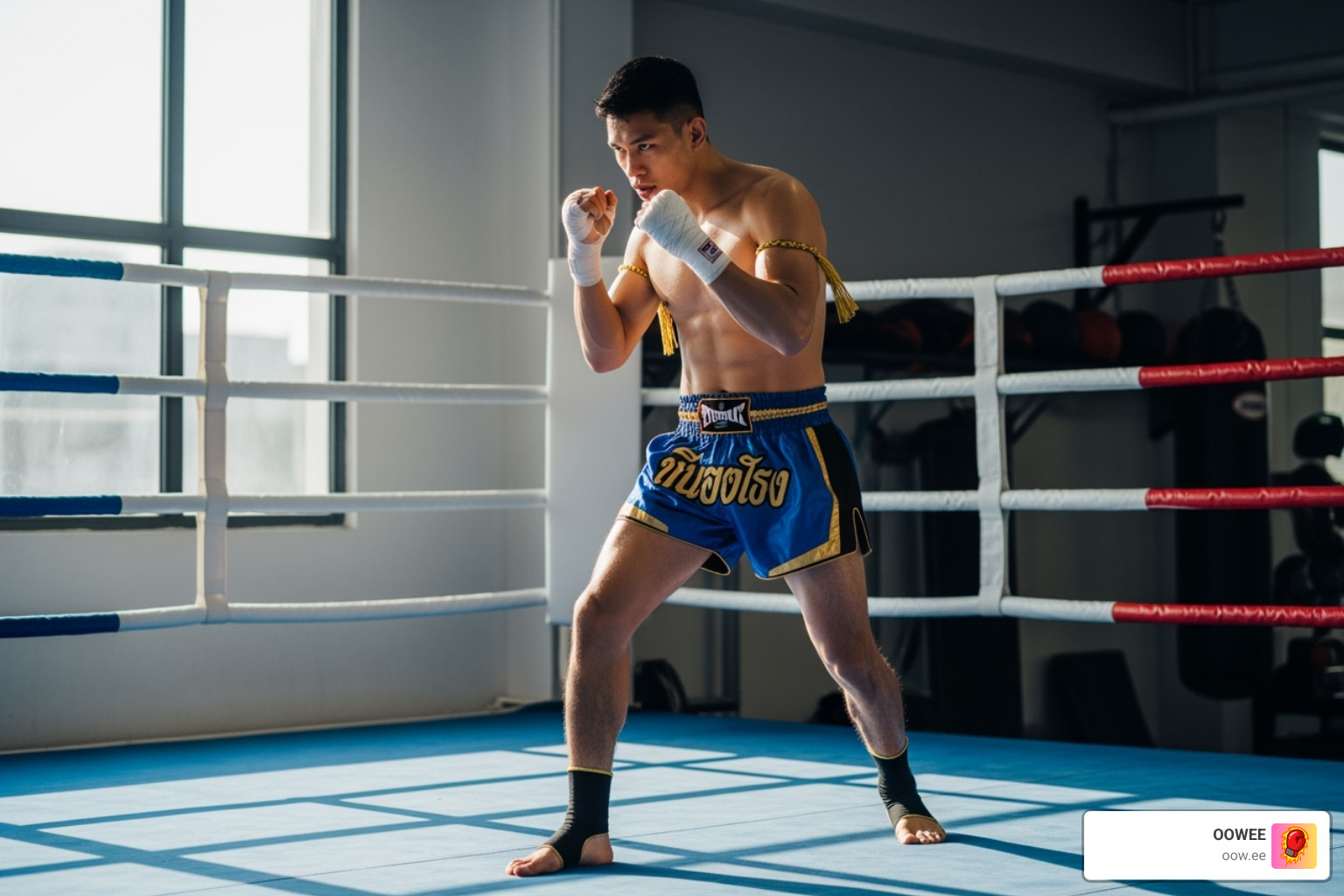
Muay Thai Stance: 5 Keys to Perfect Power
Why Your Stance is Your Superpower
The Muay Thai stance is the base that lets you hit hard, move safely, and stay defended. Without it, even great athletes get off-balance and exposed.
Key Elements of a Proper Muay Thai Stance:
- Feet: Shoulder-width apart, lead foot forward, back heel raised
-
Weight: Evenly distributed (50/50) with slight forward lean
-
Knees: Slightly bent for mobility and shock absorption
-
Guard: Hands high, elbows tucked, chin down
-
Posture: Upright but relaxed, core engaged
Strong stance = stable roots. It keeps you steady under pressure and turns the ground into power.
The Art of Eight Limbs uses punches, kicks, knees, and elbows—but your stance decides whether they land with authority or not.
Modern fighters often blend mobility and power with more balanced stances. Whether orthodox or southpaw, the fundamentals stay the same.
In this guide, you’ll tighten your base, generate more power, and move with intent.

The Pillars of Power: Deconstructing the Perfect Muay Thai Stance

Every powerful strike and safe exchange starts from your stance. It’s your anchor for balance, your launchpad for offense, and your cushion for impact.
Master three pillars: foot position, body alignment, and guard.
Foot Positioning: The Unshakeable Base

Set your feet roughly shoulder-width apart. Orthodox: left foot forward. Southpaw: right foot forward. The front foot points slightly forward to guide your movement.
Your rear foot angles out about 45 degrees with the heel slightly raised—your built-in spring for power and quick checks.
Stay light on the balls of your feet. Avoid being flat-footed so you can pivot, check, and explode without telegraphing.
Weight Distribution and Body Alignment

Start with 50/50 weight. Knees soft, hips square to the opponent, and core engaged to link legs to strikes.
Roll the shoulders slightly forward and keep the chin tucked. Head centered over your base—tall, relaxed, and ready.
The Guard: Your Shield and Sword

Hands high and close. Lead hand slightly forward to manage range; rear hand protects the chin. Elbows in to shield the body and prime elbows.
Eyes on the chest or shoulders to read movement. Keep the guard active—blocking, parrying, framing, and firing back from the same position.
The Evolution of the Stance: Traditional vs. Modern & Orthodox vs. Southpaw

The Muay Thai stance has evolved, but its core principles remain. The core ingredients are the same, but each generation adds its own twist.
Understanding these variations helps you find the stance that works best for your body type and fighting style. Whether you prefer the rock-solid traditional approach or the fluid modern style, each has its place.
Traditional vs. Modern Muay Thai Stances

The traditional Muay Thai stance was a fortress: upright, hands high, with a 90/10 weight distribution favoring the back foot. This provided incredible stability for clinch work and powerful kicks. It was like having roots that went deep into the ground.
Modern Muay Thai, influenced by other combat sports, often uses a more balanced 70/30 or 50/50 weight distribution. This allows for better boxing defense and faster footwork. It’s trading some fortress-like stability for the agility of a dancer.
Neither style is “right” or “wrong.” The best fighters can switch between both depending on what the fight demands.
Orthodox vs. Southpaw: Finding Your Dominant Side

Your stance is determined by your dominant side. Orthodox fighters (usually right-handed) place their left foot forward, keeping their power hand in the rear. Southpaw fighters (usually left-handed) do the opposite, with their right foot forward.
When an orthodox fighter faces a southpaw, it creates an “open stance” matchup. This opens up different angles of attack, such as to the liver or lead leg, which is why southpaws are often considered “awkward” opponents.
This presents problems that orthodox fighters don’t face every day.
Some advanced fighters even switch-hit—changing stances mid-fight to confuse opponents and create new attack angles.
The key is to find what feels natural. Start with your dominant hand in the back, but don’t be afraid to experiment. Trust your body—it usually knows what works best.
Stance in Motion: Essential Footwork

A perfect Muay Thai stance is useless if you can’t move with it. A perfect stance that stays glued to one spot is like having a Ferrari with no wheels. The magic happens when your stance becomes a fluid, moving fortress.
Proper footwork is about practical movement that keeps you safe and sets up your attacks. When done correctly, it should feel effortless, like you’re floating across the mat.
The Basic Steps: Forward, Backward, and Sideways

The golden rule of Muay Thai stance movement is simple: the foot closest to where you want to go moves first. This is the secret to maintaining balance while staying ready to strike or defend.
-
Move forward: Your lead foot steps first, and the back foot follows.
-
Move backward: Your rear foot steps back first, and the lead foot follows.
-
Move sideways: The foot on the side you’re moving toward steps first.
The key is taking small, controlled steps rather than big lunges. Big steps leave you off-balance and exposed. Small steps keep you stable and ready to react.
Never, ever cross your feet while moving. This is like removing the foundation from under your house. Your feet should stay on their invisible railroad tracks.
Pivoting and Creating Angles

Pivoting is your secret weapon for turning defense into offense. It’s like a magic trick that makes you disappear from one spot and reappear in a better one.
When an opponent throws a punch, instead of backing straight up, pivot on your lead foot. Your body rotates, the punch misses, and you’re suddenly at a perfect angle to counter.
The lead foot pivot is your most versatile tool. It takes you offline from attacks while setting you up for your own strikes.
Creating angles gives you tactical advantages, exposing your opponent’s ribs, centerline, or creating space to escape. Practice pivoting around cones, keeping your Muay Thai stance intact throughout the movement.
The best footwork is the kind your opponent doesn’t see coming.
Muay Thai Stance in Context: Unique Strengths and Applications

The Muay Thai stance is a specially designed platform for releaseing the full arsenal of the Art of Eight Limbs. Unlike boxing, the Muay Thai stance is more upright and square.
This might seem like it makes you a bigger target, but it’s actually tactical brilliance. That upright posture is your secret weapon for controlling distance and transitioning between all eight limbs seamlessly.
Checking kicks becomes second nature. Your balanced weight distribution lets you instantly lift your front foot and turn your shin into a shield. The attacker’s kick crashes into your check, often hurting them more than you.
Throwing kicks is more powerful. The raised back heel and square hips allow you to whip devastating roundhouse kicks without telegraphing your intentions.
Knee strikes become devastating weapons. Your upright posture is perfectly aligned to drive knees upward with maximum force, especially in the clinch.
Elbow strikes are always ready. Those tucked elbows aren’t just protecting your ribs; they’re cocked and ready to slash or drive upward in tight quarters.
The clinch game is where this stance truly dominates. Your upright posture and square positioning make you a natural clinch fighter, able to control your opponent and land knees.
Think of it this way: other stances are specialized tools, but the Muay Thai stance is a Swiss Army knife. It gives you instant access to the most complete striking system ever developed.
Mastering Your Foundation: Drills and Common Mistakes

Mastering the Muay Thai stance isn’t a one-time lesson. It requires constant attention and practice until it becomes second nature, an unshakeable foundation for your entire Muay Thai journey.
Drills to Forge an Iron Stance

Building a rock-solid Muay Thai stance requires consistent, focused practice. These drills help develop the muscle memory you need.
- Mirror Work: Use a mirror to check your form. Move, shadowbox, and always return to your base. The mirror doesn’t lie.
-
Balance Training: Stand on one leg or use a balance board to build stability. Skipping rope also develops lightness on your feet.
-
Footwork Squares: Mark a square on the floor and move around its perimeter to drill the “lead foot first” rule.
-
Partner Resistance: Have a partner gently push or pull you while you hold your stance to learn how to brace against external forces.
-
Dynamic Pad Work: Focus on returning to a perfect stance after every strike on the pads or heavy bag.
Make these drills part of your regular routine. Five minutes of stance work before each session will pay massive dividends.
Common Mistakes in the Muay Thai Stance (And How to Fix Them)

Awareness is half the battle in fixing bad habits. Here are the most common Muay Thai stance errors and their fixes:
- Standing flat-footed: You become slow and predictable. Fix: Stay light on the balls of your feet with your back heel slightly raised.
-
Wrong stance width: Too wide and you’re immobile; too narrow and you’re unstable. Fix: Keep feet shoulder-width apart.
-
Dropping your guard: A recipe for getting knocked out. Fix: Keep your hands near your chin and elbows tucked.
-
Leaning too much: This kills your balance. Fix: Keep your weight centered and your head over your base.
-
Chin up in the air: An easy target for your opponent. Fix: Tuck your chin down toward your chest.
-
Crossing your feet: An instant balance killer. Fix: Keep your feet on parallel tracks as you move.
Once you know what to look for, you can catch yourself and make corrections. With time, a proper stance becomes natural.
Conclusion: Build Your House on Rock

Your Muay Thai stance isn’t just how you stand—it’s who you are as a fighter. Every knockout, every perfectly timed counter, and every moment you stay standing when others would fall starts here, with your feet planted and your guard up.
You now know the fundamentals of the Muay Thai stance: the lifted rear heel for explosive power, the tucked chin for safety, and the tucked elbows that protect your ribs while setting up counters.
But knowledge is useless without practice. Your stance needs to become muscle memory, something so natural that you no longer have to think about it.
The beauty of modern training is that you don’t need a gym to perfect your fundamentals. With voice-guided training, you can work on your stance anywhere. The key is consistency over perfection. Five minutes of daily stance work beats an hour once a week.
Even world champions still drill their stance. It’s never “good enough” because it’s the foundation everything else is built on. When your stance is rock-solid, your kicks become thunderous, your punches gain snap, and your defense becomes impenetrable.
Your journey in Muay Thai starts with a single step—literally. Plant your feet, raise your guard, and begin building the foundation that will carry you through every fight.