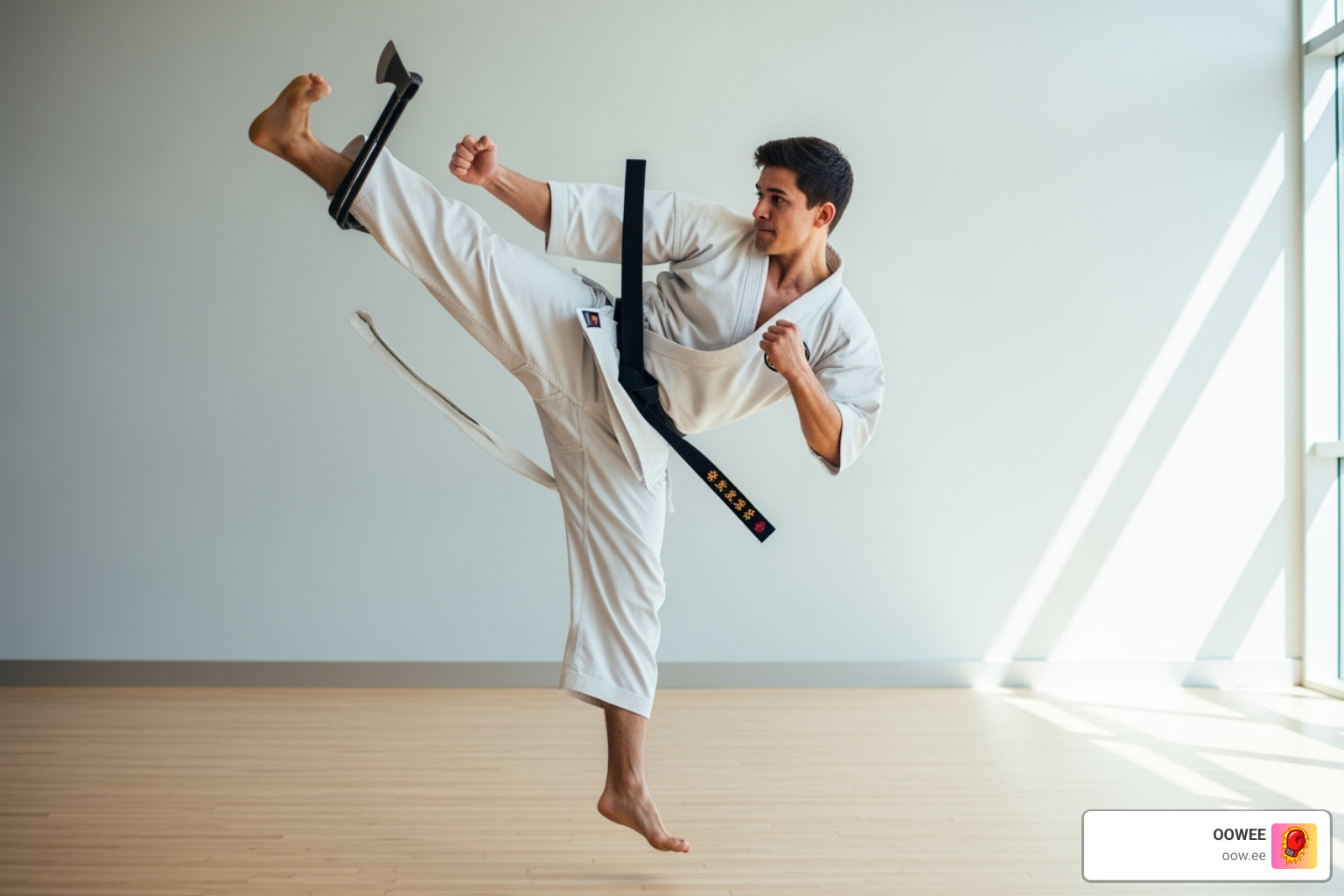
Axe kick tutorial: Unleash 1 Powerful Kick!
What Makes the Axe Kick So Effective?
An axe kick tutorial starts with understanding why this technique is so devastating. Unlike horizontal kicks, the axe kick drops straight down like a hammer, using gravity and your body weight to deliver crushing force.
Quick Axe Kick Tutorial Overview:
- Stance: Start in a solid fighting position.
-
Lift: Raise your leg straight up as high as possible.
-
Strike: Drop your heel straight down onto the target.
-
Recovery: Quickly return to your starting stance.
The axe kick’s power comes from its unique downward trajectory, attacking from above your opponent’s guard.
The heel becomes a devastating weapon, targeting the head, collarbone, or shoulder.
This element of surprise makes it a “savage weapon” in Muay Thai and a point-scorer in Taekwondo.
Mastering this kick requires flexibility and strength, but it provides a powerful tool when traditional attacks fail. It’s also known as the Hammer Kick or, in Korean, naeryeo chagi.

The Complete Axe Kick Tutorial
Ready to master one of martial arts’ most devastating techniques? This axe kick tutorial will transform you from curious beginner to confident striker. We’re breaking down everything from the physical foundation you need to the precise mechanics that make this kick so effective.
Building the Foundation: Flexibility and Strength
Before you even think about launching your leg skyward, let’s talk about what your body needs to succeed. The axe kick isn’t just about raw power – it’s about having the right combination of flexibility and strength working together.

Flexible hamstrings and hips are non-negotiable. They allow you to lift your leg high, which is crucial for generating downward force.
Without flexibility, you’re not only sacrificing power but also risking a pulled muscle. Your core and glutes provide stability, while your quadriceps control the leg’s path.
Essential Exercises:
- Dynamic Leg Swings: Warm up your hips and hamstrings.
-
Standing Hamstring Stretches: Hold for 30 seconds to increase flexibility.
-
Butterfly Stretches: Open up your hips for better range of motion.
-
Single-Leg Squats & Planks: Build the core and leg stability you’ll need to stay balanced.
-
Romanian Deadlifts & Kettlebell Swings: Strengthen your hamstrings and glutes for a more powerful strike.
Step-by-Step Axe Kick Breakdown
Now for the main event. This axe kick tutorial breaks down the technique into four distinct phases that flow together like a deadly dance.

Phase 1: Your Fighting Foundation
Start in a natural fighting stance with feet shoulder-width apart. Your weight should feel evenly distributed, and your hands stay up protecting your face. This isn’t just about looking ready – this stance gives you the stable platform you need for explosive movement.
Phase 2: The Upward Journey
Here’s where the magic begins. Lift your kicking leg as high as humanly possible, keeping it relatively straight. Think of drawing a large vertical arc with your foot. Your toes point upward and your foot bends slightly back, preparing your heel to become the primary weapon.
Phase 3: The Critical Peak
At the highest point, there’s a brief moment of suspension. This isn’t a pause, but rather the apex where your upward momentum transitions to gravitational pull. Your leg should still be straight, ready for the devastating descent.

Phase 4: The Devastating Drop
Now comes the “axe” part of the axe kick. Drive your heel straight down with controlled fury, letting gravity amplify your muscular force.
Aim to strike through the target rather than just tapping it, maximizing energy transfer. As you strike, pivot on the ball of your supporting foot to add rotational force and help you maintain balance.
Common Mistakes and How to Fix Them
Even experienced martial artists stumble with the axe kick. Let’s address the most common pitfalls so you can avoid them entirely.
-
Losing Balance: If you’re wobbly, your kick is too high for your current strength. Lower the height and focus on core exercises.
-
Bending the Knee: A bent knee kills your power. Keep the leg straight throughout the motion, with only a slight bend at impact to protect the joint.
-
Wrong Striking Surface: Always strike with your heel, not the arch or ball of your foot.
-
Over-rotating Hips: This turns your axe kick into a weak crescent kick. Keep the movement vertical.
-
Forcing Flexibility: Don’t rush it. Consistent stretching is safer and more effective than forcing a high kick and getting injured.
-
Exposing Your Groin: The axe kick leaves you open. Practice a quick execution and immediately return to your defensive stance.
Mastering Your Axe Kick
Drills to Sharpen Your Technique
Perfecting the axe kick requires dedicated practice. These drills will help you build muscle memory and power.

-
Slow-Motion Kicks: Execute the kick as slowly as possible to perfect your form and balance.
-
Balance Holds: Hold your leg at the peak of the kick for 10-15 seconds to build stability in your supporting leg.
-
Target Practice: Use a heavy bag or a partner holding a pad. Focus on striking with your heel and driving through the target.
-
Resistance Bands: Wrap a band around your ankle to add resistance, strengthening your hip flexors and glutes through the entire range of motion.
The OOWEE app can guide you through these drills with real-time audio cues, letting you focus on your form without counting reps.
Smart Setups for Sparring and Self-Defense
The axe kick’s greatest strength is surprise. Since most opponents expect horizontal attacks, a vertical strike can be devastating.
-
Targeting: Aim for the head, collarbone, or shoulders. A solid hit to the collarbone can disable an opponent’s arm.
-
Timing: Use it against opponents with a high guard or as they are moving forward.
-
Setups:
-
Fake a low kick to make them drop their guard, then bring the axe kick over the top.
-
Throw a quick jab-cross combination to distract them, then follow up with a rear-leg axe kick.
-
In a self-defense situation, the axe kick is a powerful tool, but its high-risk nature means you should only use it when you have a clear opening.
Axe Kick Variations and Pro Tips
Once you’re comfortable with the basic axe kick, you can add variations to your arsenal.
-
Inside/Outside Axe Kicks: Instead of a straight line, your leg travels in an inward or outward arc before dropping, changing the angle of attack.
-
Front Leg Axe Kick: Faster but less powerful, this is great for catching an opponent off guard.
-
Jumping/Spinning Axe Kicks: These are advanced, high-risk, high-reward techniques that require exceptional athleticism and control.
The axe kick has a rich history in martial arts like Taekwondo and Muay Thai. The core principles remain the same: prioritize flexibility, master the technique before adding power, and always strike with the heel.
Consistent practice is the key. Regular, focused training will build the muscle memory needed to execute this powerful kick effectively.
Ready to integrate these techniques into a structured training program? Explore personalized Muay Thai training with OOWEE, where voice-guided instruction helps you perfect every aspect of your axe kick technique.
Mastering Your Axe Kick
Drills to Sharpen Your Technique
Perfect technique doesn’t happen overnight. The axe kick tutorial journey requires dedication, smart practice, and the right training approach to develop the muscle memory your body needs.
Think of learning the axe kick like learning to drive. You wouldn’t start by racing on the highway – you’d practice in an empty parking lot first. That’s exactly why slow-motion axe kicks are so valuable. Execute each phase deliberately: the lift, the peak, the chop, and the return.
This builds proper form into your nervous system before speed becomes a factor.
Balance drills transform your supporting leg into an unshakeable foundation. Try holding your kicking leg at peak height for ten seconds. It sounds simple, but it’s surprisingly challenging.
Single-leg squats and balance board exercises also work wonders for stability.
Once your form is solid, target practice sharpens your accuracy. Start with a piece of tape on the wall, then progress to hanging foam pads.
Sweet spot we discussed – aim to strike through the target, not just at it. Your heel should land with authority every single time.
The heavy bag becomes your best friend for developing knockout power. Each strike should feel like you’re chopping through the target.
Keep that foot locked at impact – any wobbling wastes precious energy and reduces effectiveness.
Resistance band training builds the specific strength your hamstrings and hip flexors need. Attach the band to your ankle and practice the full motion against resistance.
It’s like weight training specifically designed for your axe kick.
Here’s where modern technology makes a real difference. With OOWEE’s training features, you get personalized vocal cues that guide you through each drill.
No more counting reps in your head or wondering if your form is correct – the app keeps you focused on pure execution.
Smart Setups for Sparring and Self-Defense
The axe kick’s biggest advantage? Most fighters never see it coming. While everyone expects roundhouses and front kicks, this vertical attack bypasses conventional thinking entirely.
Strategic timing makes all the difference in sparring. Watch for opponents with high guards – they’re practically begging for an over-the-top attack.
Advancing fighters walk directly into your strike zone, amplifying the impact through their own momentum.
Your primary target zones include the head, neck, collarbone, and shoulders. These areas are typically well-protected against horizontal attacks but vulnerable from above.
A well-placed strike to the collarbone can instantly drop an opponent’s guard.
The art lies in the setup. Fake a front kick to make them expect a body shot, then bring that leg straight down over their lowered guard.
Throw a jab-cross combination to occupy their vision, then explode into a rear-leg axe kick while they’re distracted.
Distance management is crucial – you need enough space to fully extend your leg but close enough to land with power.
Practice reading that perfect striking distance until it becomes instinctive.
For self-defense scenarios, the axe kick’s stopping power makes it effective, but use it wisely. The high leg position can leave you vulnerable if the technique fails.
Reserve it for clear openings when you have space and time to execute properly.
Axe Kick Variations and Pro Tips
Once you’ve mastered the basic technique, several variations can expand your arsenal and keep opponents guessing.
The inside axe kick follows an outward arc, while the outside axe kick curves inward. Both offer different angles of attack and can catch opponents who’ve adapted to your straight-down approach.
Front leg axe kicks sacrifice some power for speed and surprise. They’re perfect for quick setups or catching aggressive opponents off-guard.
The jumping variation adds spectacular height and power but demands exceptional balance and timing.
Advanced practitioners might explore the spinning axe kick, which generates tremendous rotational force. However, this athletic technique requires extensive practice and perfect timing to execute safely.
The axe kick’s historical roots run deep through traditional martial arts. From ancient Muay Boran to modern Taekwondo competitions, this technique has proven its effectiveness across cultures and centuries.
Modern applications extend beyond combat. Many instructors use axe kicks as dynamic stretching exercises that build flexibility, balance, and body control simultaneously.
Key principles for beginners remain constant: flexibility comes first, technique trumps power, and the heel is always your weapon.
Consistent practice builds the muscle memory that makes this devastating technique feel natural.
Your training consistency matters more than occasional intense sessions. Regular practice with proper form creates the foundation for explosive power when you need it most.
Ready to integrate these techniques into a structured training program? Explore personalized Muay Thai training with OOWEE, where voice-guided instruction helps you perfect every aspect of your axe kick technique.